ESG in Office Spaces: How the Workplace Supports Business Goals
 28 Sept
Key Takeaways
- A sustainable workplace needs efficient infrastructure, reliable ESG data and strong day-to-day management.
- ESG in office spaces covers energy, water, waste, employee wellbeing and responsible building operations.
- Managed offices can help businesses simplify ESG reporting and maintain consistent workplace standards across locations.
In a recent survey of occupiers in India, 63% said they now have ESG goals linked to their real estate, and nearly three in four called workplace design a priority. Read together, the two figures point one way - the office is an integral part of the ESG plan for businesses that are scaling quickly or reporting into a global group.
Where ESG Meets the Workplace
Most ESG discussions take place in reports and dashboards. A lot of the numbers in those reports start in the office, though. A chiller runs through a humid afternoon, a meter ticks on the service floor, and mixed waste leaves the loading bay. Facility teams track all of this as operating cost, and it resurfaces at year end as sustainability data.
Inside a building, the three pillars also overlap more than frameworks suggest. HVAC is a good example. When it is tuned well, the power bill falls, and the floor gets fresher air too, which shows up in how long people can stay focused through the afternoon. And the building management system that runs it generates the consumption data a sustainability team need. A single system can touch all three pillars.
Why the Office Is Now Part of the ESG Conversation
BRSR has raised the value of reliable building data SEBI requires the top 1,000 listed companies by market capitalisation to file Business Responsibility and Sustainability Reports. BRSR Core adds a narrower set of indicators subject to assurance, being introduced in phases.
The office is one input among many in these filings. Its contribution is far easier to report when the building meters energy, water and waste properly. Where that metering is incomplete, teams are often left compiling estimates from invoices, which makes the numbers harder to verify and defend.
When Global ESG Targets Reach the Indian Office
Many GCCs and multinational subsidiaries in India report into group-level sustainability programmes. Where that is the case, the Indian office may need to meet targets, data formats or workplace standards defined elsewhere.
This puts local conditions in focus. Climate, grid reliability and water availability vary across Indian cities, and a building's ability to perform against group targets depends on how well it has been designed for its location.
Where Sustainability Meets Workplace Experience
Rent and location remain central to any office decision. Alongside them, employees increasingly notice air quality, natural light, quiet space and accessibility. As a result, sustainability and employee experience are now often assessed together when companies evaluate a workplace.
The Environmental Footprint Starts Before Move-In
Buildings are estimated to account for around a third of global energy use and energy-related emissions. For an occupier, the building chosen will shape a significant part of the office's environmental footprint from the first day of operation.
Start With the Building's Biggest Energy Loads
In most Indian offices, cooling is the largest single contributor to electricity consumption, with lighting and ventilation following. The most substantial savings therefore tend to come from the base building: efficient central plant, a properly configured BMS and controls that respond to actual occupancy. Individual tenants can improve efficiency within their own floors, but the scope is narrower once core systems are already in place.
Water Strategy Has to Fit the City
Rainfall, groundwater and municipal supply vary widely across India, and they shift with the seasons. Buildings in cities where supply is tight gain the most from treating their own wastewater and reusing it for flushing and landscaping. Where supply is more stable, efficient fixtures may address most of the need. A building is best judged against the conditions of its own city rather than a national average.
Make Responsible Waste Management the Default
A waste policy tells employees what is expected of them. Whether they follow it depends largely on what they find at the pantry and the printer. Clearly marked segregation points, reliable collection by authorised recyclers and a defined process for retiring IT equipment all make responsible disposal the default rather than an extra step. E-waste in particular benefits from clear ownership, so that devices are tracked through to certified disposal.
Green Certification Is Becoming the Baseline
The market has moved quickly here. In the last quarter of 2025, green-certified buildings accounted for more than 90% of new office supply in India and roughly three-quarters of leasing.
ESG Is Also About How the Workplace Feels to Use
An office can perform well on efficiency and still fall short as a place to work. The social pillar is judged by the people using the space, across the full working day.
Indoor air quality is a good example. When CO₂ levels rise in occupied rooms, comfort and concentration can decline. Buildings with CO₂ and occupancy sensors allow facility teams to increase fresh air where it is needed, rather than adjusting the whole floor. Lighting, acoustics and thermal comfort contribute in similar ways.
Accessibility deserves specific attention during evaluation. Step-free routes from arrival to workspace, accessible washrooms on each occupied floor and clear wayfinding all affect employees and visitors daily. These are best checked in person, along the routes people will use.
Workplace variety matters as well. A typical day includes focused work, team discussions and external calls. Providing a range of settings, from phone booths to bookable meeting rooms and informal collaboration areas, allows people to choose a space that suits the task instead of adapting every activity to an open floor.
Good Building Performance Needs Good Management
Governance receives less attention than the other two pillars, but it has a direct bearing on whether a building continues to perform as intended.
In practice, it covers routine and documentation: fire and evacuation drills conducted and recorded, access control and visitor management, information security, vendor selection and oversight, preventive maintenance with compliance records, and transparent reporting on consumption.
Without consistent management, building performance can decline over time. Filters and sensors need regular attention, and meters need to be read and reconciled. Strong governance helps ensure that the performance a building demonstrates at handover is maintained through the term of occupancy.
Where the Workplace Operator Fits Into ESG
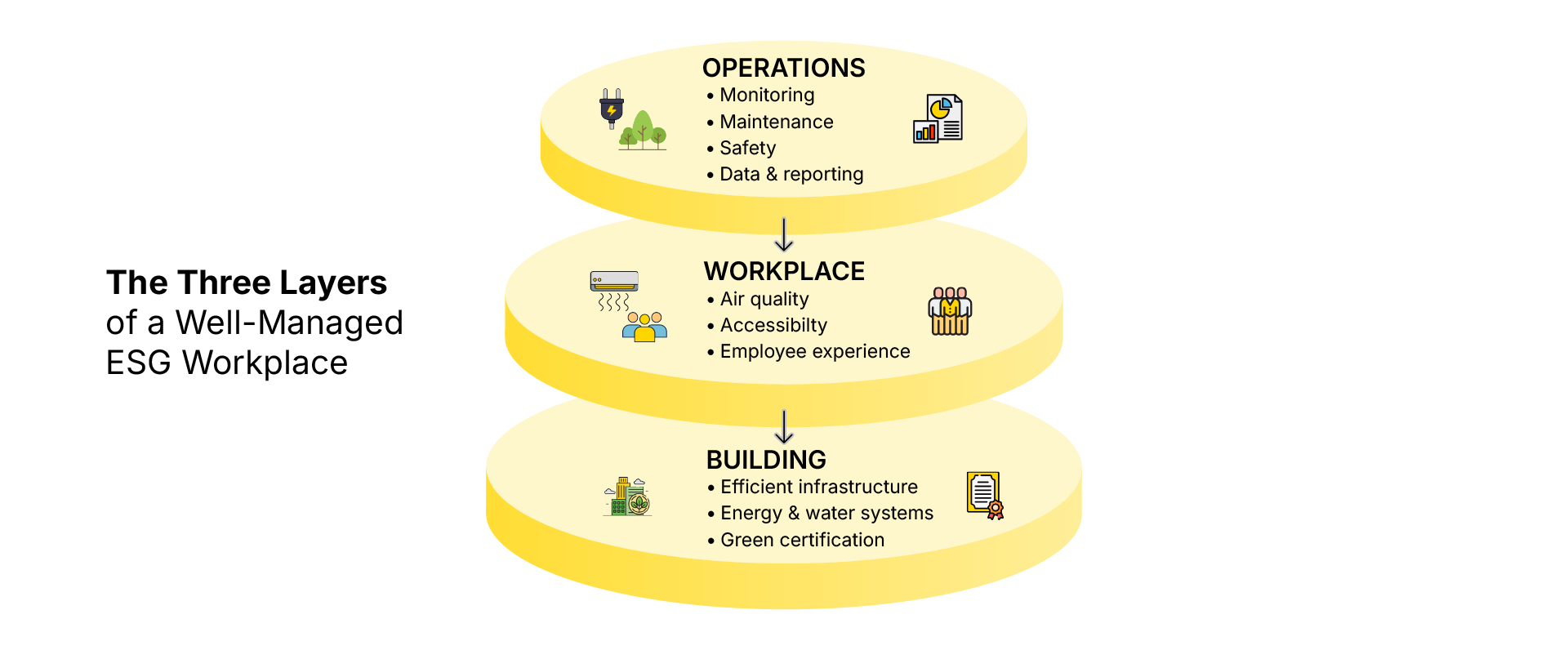
At Smartworks, ESG is considered as part of the way a workplace is planned and managed, from the building and its infrastructure to energy and water management, waste handling, safety, accessibility and everyday employee experience.
With managed workplaces across 14 cities, the same focus on operational consistency can extend across locations, while still allowing each workplace to respond to its local context.
For businesses building teams across India, that makes a real difference. The right office makes the connection between business goals and the workplace where they are executed easier to manage, measure, and maintain over time.
Frequently Asked Questions
It refers to how an office manages resource efficiency, employee wellbeing and responsible operations through its design and day-to-day management.
Through efficient energy and water use, responsible waste handling, a healthy and accessible environment, sound safety systems and reliable operational data for reporting.
Certification is a strong indicator of building performance, but it does not cover wellbeing, safety or ongoing management in full. Those need to be assessed separately.
They can, by consolidating building services, facility operations and workplace data under a single operator. Occupiers should confirm the scope and frequency of the data provided.
Many GCCs reports into group-level sustainability frameworks. An office that performs well on energy, wellbeing and governance makes it easier for Indian teams to meet those expectations.