How Managed Offices Reduce Operational Burden for Enterprises
 24 Jul
Key Takeaways
- An office is a function to run, not only a space to occupy, and there is more of it to run as a company grows.
- Payroll and IT have already moved to specialists. Office operations is the next function heading the same way.
- With a managed model, one provider takes on fit-out, facilities, and vendors, giving leadership room to focus elsewhere.
An office is easy to picture as a place. In practice, it works more like an operating system.
Keeping it running takes more than is visible. There are vendors to coordinate and systems to maintain. The technology must stay up, the space has to stay clean, compliance has to be current, and dozens of small decisions have to be made to move the day along.
As companies grow, many are starting to ask about their offices the same question they once asked about payroll and IT - Does all this really need to sit in-house?
The Function Hiding Inside Your Office
Running an office is not a distraction from operations. It is operations, an entire function with its own vendors, contracts, renewal cycles, and pressure points, sitting inside a company that was never set up to be in the business of facilities management.
It tends to go unnoticed because it never arrives as a single task. A renewal comes due. A security roster needs signing off. A fit-out detail needs attention. An invoice needs a second look. On its own, each one is small. Together, they become a real job, shared across a facilities team, an admin function, and often a few people whose main role lies elsewhere.
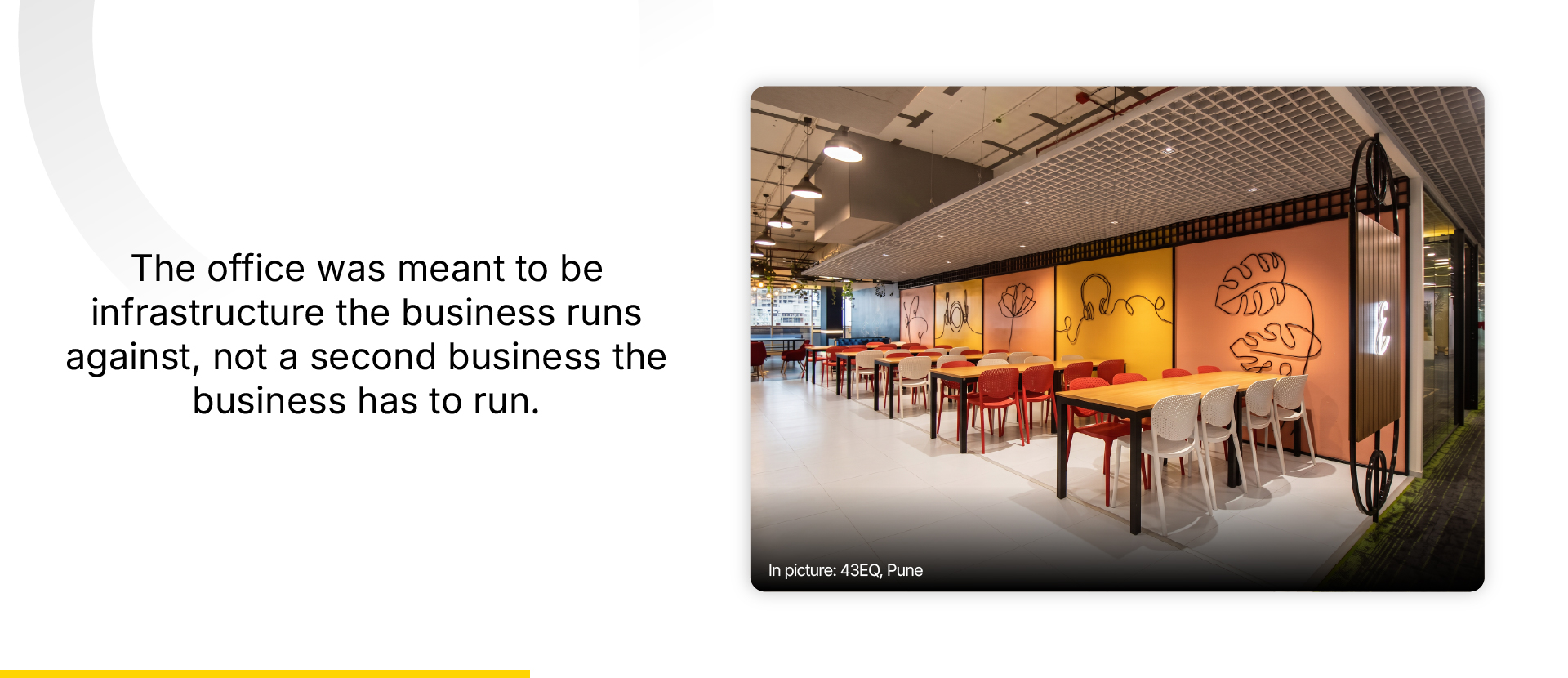
That job also grows over time. A team of forty can take a broken lift in its stride. A team of four hundred, working across two floors in two cities, needs dedicated time and people to keep everything moving. As a company expands, this work builds with it, and it steadily draws senior attention toward the efficient running of the building
Outsourcing Operations, the Way You Already Have
Enterprises have made this kind of move before. Payroll went to specialists who ran it on scale. IT moved to managed services that keep systems steadier than a stretched internal team usually can. The thinking behind each was the same. The work matters, but it is not the reason the company exists, so it makes sense to hand it to people who focus on nothing else.
A managed office brings that same thinking to the workplace itself. Rather than sourcing vendors, agreeing terms with each one, and overseeing them all, a company hands the whole of it to a single provider. Fit-out, furniture, housekeeping, security, utilities, and IT, all under one agreement.
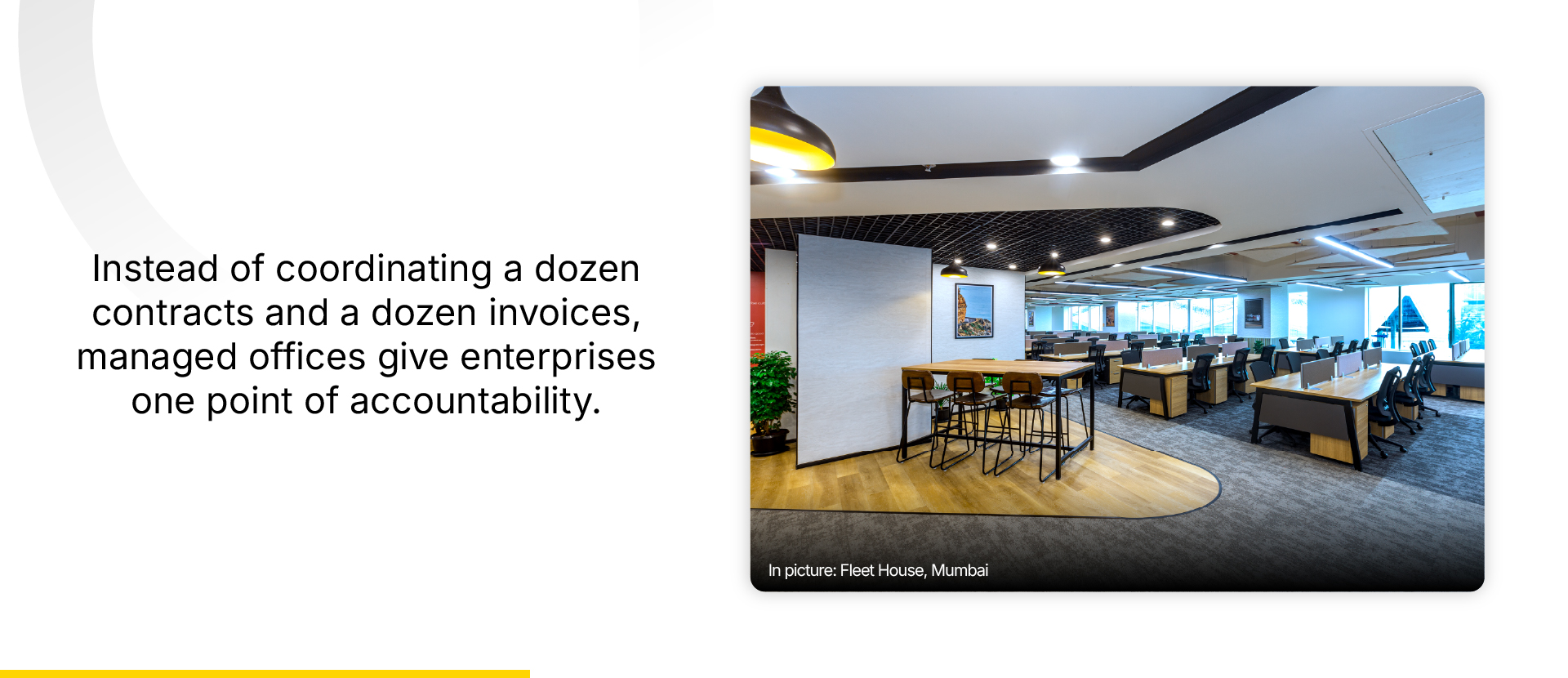
It reads like a small change and works like a significant one. In a fragmented arrangement, the company becomes the coordinator whenever something needs fixing, following up with one vendor while the rest look to each other. With a single provider, that coordination sits with them. The company steps out of the middle and returns to being the client.
What the Enterprise Gets Back
The clearest gain is financial, as costs settle into one predictable figure rather than several that shift with every repair and renewal. The gain that tends to matter more, though, is attention. An hour spent reviewing a housekeeping invoice is an hour not spent on the floor plan, on how people experience their workplace, or on the next city the business hopes to open in. Handing over the operational load is really a way of giving that attention back to work that needs it.
Why More Enterprises Are Making the Move Now
This is no longer a niche choice. Across India, demand for managed office space now comes more from established enterprises than from startups, and the shift is driven by real structural factors rather than fashion.
GCCs Set the Pace
Global capability centres have reshaped what a workspace is expected to offer. A GCC setting up an engineering or research team in a new Indian city needs space that is ready quickly, matches the standards the wider organization works to, and feels familiar to colleagues visiting from elsewhere. The managed model meets that need closely, which is why so much GCC growth now moves through it.
Core Markets are Tightening
In established business districts, securing quality space on a conventional timeline has become genuinely difficult. Faced with a choice between a long build-out in a supply-constrained micro-market and a workspace ready to occupy in a fraction of the time, more companies are choosing the space that lets them begin sooner.
Growth is Spreading Outward
The demand reaches well beyond the traditional metros now. Stronger road and air links, better digital infrastructure, and supportive state-level incentives have made expansion into newer cities practical. Companies increasingly trust that a managed provider will hold the same standard in those markets, without them needing a local team on the ground to oversee it.
Where Smartworks Fits In
Delivering this well in a single building is one thing. Delivering it consistently across many cities, at the scale enterprises work at, is another, and this is where scale genuinely matters. Smartworks runs the largest managed office footprint in India by area under management, working with enterprises, multinationals, and GCCs as the partner that runs their space.
That scale is what keeps the experience consistent. Because delivery and service standards stay the same from one location to the next, a company growing from one city to three is not renegotiating quality each time but continuing with a setup it already knows well. When the real work of the business lies elsewhere, that consistency is the whole reason for handing the workplace over in the first place.
Frequently Asked Questions
A managed office is a fully operational workspace where the provider handles setup, fit-out, maintenance, security, and IT infrastructure on the enterprise's behalf, delivered under a single monthly relationship. The business moves in and starts working rather than building and running the office itself.
It brings the many separate parts of running an office, from facilities and housekeeping to security, utilities, and IT, into one relationship with one point of accountability. That removes the coordination an enterprise would otherwise carry across a long list of individual vendors.
Yes. Enterprises and global capability centres are now among the largest adopters of the model, drawn by quick occupancy timelines, consistent standards across cities, and the freedom to focus their own resources on their core work rather than on facilities.
Most agreements cover fit-out and furnishing, housekeeping, maintenance, security, utilities, and core IT infrastructure, along with a growing layer of workplace technology and experience services. The exact scope varies by provider, so it is worth confirming what sits inside the monthly fee before comparing options.
A well-run managed office is built for exactly this. Established providers can usually accommodate growth within the same location or extend into new cities, without the business having to restart the sourcing and setup process each time.