How to Choose an Office Space: 5 Things to Consider
 17 Nov
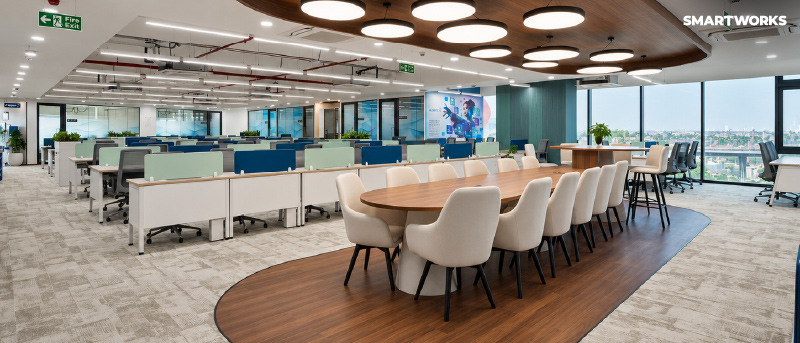
An office is one of the most visible decisions a company makes. It shapes how teams collaborate, how clients experience the business, and how quickly the organisation can move when opportunity arrives. India's office market reflects this shift in thinking. Industry reports suggest flexible workspace made up about 20% of all office leasing in H1 2026, as companies look for workplaces that move at the pace of the business.
Here is a practical framework for making the choice.
Is the Location Right for Your People and Your Business?
A good location shortens the commute for most of your team and places you close to the clients, partners and talent you want to reach.
Location is the factor teams feel every single day. When evaluating a site, look at:
- Commute and transit: How easily can people reach the office by metro, bus or the main arterial roads? A short, predictable commute makes coming in an easy choice.
- The business neighbourhood: Being part of an established commercial district places you near clients, partners and the wider ecosystem of your industry.
- Talent catchment: Where do the people you plan to hire live? An office within their reach widens your hiring pool.
- Arrival experience: Parking, drop-off points and a clear, welcoming entrance set the tone for every employee and visitor.
For companies operating across several cities, consistency matters as much as any single address. A partner with campuses across multiple markets lets you choose the right micro-market in each city while keeping the same standard everywhere.
What Is the Total Cost of Occupancy, Beyond the Rent?
The most useful budget looks at the full cost of running the office: rent, maintenance, utilities, fit-out, technology and day-to-day operations, viewed together over the term.
Rent is the starting point of an office budget, and a complete picture brings in every line item that keeps the workplace running:
- Recurring costs: Common area maintenance, power, water, housekeeping, security and connectivity.
- Upfront investment: Security deposits, interior design, furniture and IT set-up.
- Time to occupancy: The months between signing and moving in, and the management attention the project needs along the way.
Comparing options on a single, all-inclusive figure makes the decision clearer. A managed office brings these elements into one predictable cost, so finance teams can plan with certainty and leadership can direct capital towards growth.
Can the Space Grow and Change With Your Team?
The right office fits your current team comfortably and gives you a clear path to expand, consolidate or open new locations as plans evolve.
Headcount plans change, and the best workplaces are designed to keep pace. Consider:
- Room to scale: Can you add seats, or a full floor, in the same building as the team grows? Large floor plates allow teams to expand while staying together.
- The right mix of spaces: A balance of open collaboration areas, focus rooms, private cabins and well-equipped meeting rooms supports the different kinds of work that happen through the day.
- Flexible terms: Lease structures that align with business planning cycles keep options open.
- Multi-city reach: A hub-and-spoke model, or a single consolidated regional office, both benefit from a partner that operates in several cities.
This is where large, managed campuses come into their own. They suit scaling teams, mid to large teams and companies bringing a regional footprint together into one office.
Is the Infrastructure Ready for How Your Teams Work?
Reliable connectivity, smart meeting rooms, uninterrupted power and secure access are the foundation that lets teams work without interruption from day one.
Strong infrastructure is often invisible when it works well, which is exactly the goal. Check for:
- Connectivity: High-speed, redundant internet and secure network design suited to your data and compliance needs.
- Meeting technology: IoT-enabled, video-conferencing-ready rooms, easy booking systems and good acoustics for hybrid collaboration.
- Power and continuity: Dependable power backup and building systems maintained to a consistent standard.
- Security: Access control, concierge services, CCTV and professional front-desk management for employees and guests.
- Sustainable building design: Green, energy-efficient buildings with efficient lighting and cooling and water-saving systems lower running costs and support the company's ESG goals.
Global businesses and GCCs in particular look for infrastructure that meets their global standards from the first day of operations. A professionally managed office space delivers this as part of the workplace, with a dedicated operations team keeping it running smoothly
Will Your People Enjoy Coming to Work Here?
The best offices give people reasons to come in: natural light, comfortable workspaces, places to recharge and amenities that make the workday easier.
Employee experience has become central to workplace strategy, because the office is where culture, learning and collaboration come together. Look for:
- Wellbeing: Natural light, good air quality, acoustic comfort and ergonomic furniture.
- Places to recharge: Cafeterias, lounges, gyms and sports facilities such as pickleball courts or cricket nets.
- Everyday convenience: On-site creches, convenience stores and services that help employees balance work and life.
- Spaces to gather: Event areas for town halls, celebrations and client sessions that build a sense of community.
When the office space itself offers these, the office becomes a destination that people choose, and a strong asset for attracting and retaining talent.
How Do You Bring All Five Factors Together?
Score each shortlisted option on all five factors, then choose the one that best fits your growth plans, not just your current needs.
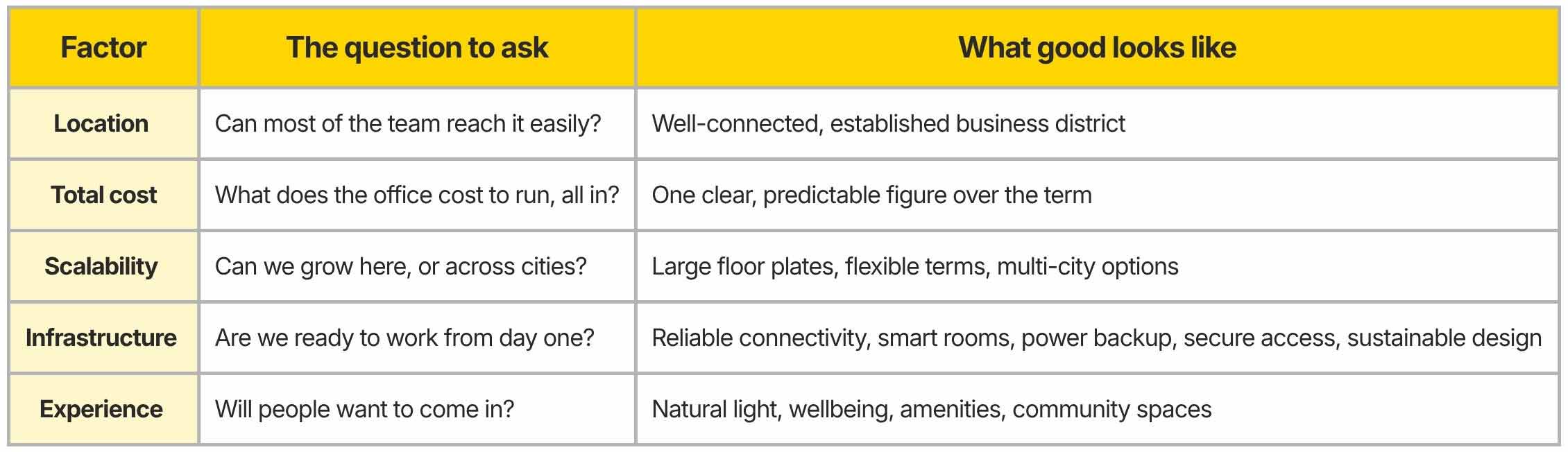
Choose the office that serves your people, your budget and your growth plans together. When location, cost, scale, infrastructure and experience align, the workplace becomes a lasting advantage for the business.
Frequently Asked Questions
Location is usually the first filter, because it shapes the daily commute and access to talent and clients. The best decisions, however, weigh location alongside total cost, scalability, infrastructure and employee experience.
It is the full cost of running an office: rent plus maintenance, utilities, fit-out, furniture, technology, security and day-to-day operations. Comparing options on this all-in figure gives a clearer view than rent alone.
Space needs depend on your work style, the mix of collaboration and focus areas, and your hiring plans. A good starting point is your current headcount plus your expected growth over the next 12 to 24 months, with an option to expand in the same building.
A managed office is a workspace designed, fitted out and managed by a workspace partner so the business can focus on its work. The company gets a ready-to-use, customised workplace with infrastructure, amenities and operations included, usually at one predictable cost.
Yes. Large managed campuses with office space providers like Smartworks are well suited to mid to large scaling teams, GCCs and global businesses that want customised space, global-standard infrastructure and the ability to expand across cities.