Managed Office vs Traditional Lease: What’s Right for a 300+ Seat Team?
 12 Jun
Key Takeaways
✓ Traditional leases are capital-heavy and inflexible: best suited to organizations with stable, long-horizon headcounts.
✓ Coworking scales well to 50 seats. At 300+, the economics and the brand experience both work against you.
✓ Managed offices deliver enterprise-grade infrastructure with operational simplicity, transparent pricing, and city-scale flexibility.
Flex became the single largest occupier segment in India’s office market in Q4 2025 for the first time ever. This is no longer a trend. It is a structural shift in how large organizations think about workspace. For leadership teams navigating a 300+ seat decision, the workspace model you choose shapes how your teams work together, how quickly you can expand to a new city, and how much operational weight your business quietly carries.
Traditional Leases: High Control, High Commitment
The control a traditional lease offers comes with a trade-off most finance teams only fully quantify once they are already committed: you own every cost, every vendor relationship, and every operational decision that keeps the space running.
Fit-out, facilities management, utilities, security, and IT infrastructure are each a separate contract to negotiate and manage. For an organization in growth phase, that complexity compounds quietly in the background until it becomes difficult to separate from the business itself.
What You Are Paying Beyond the Rent
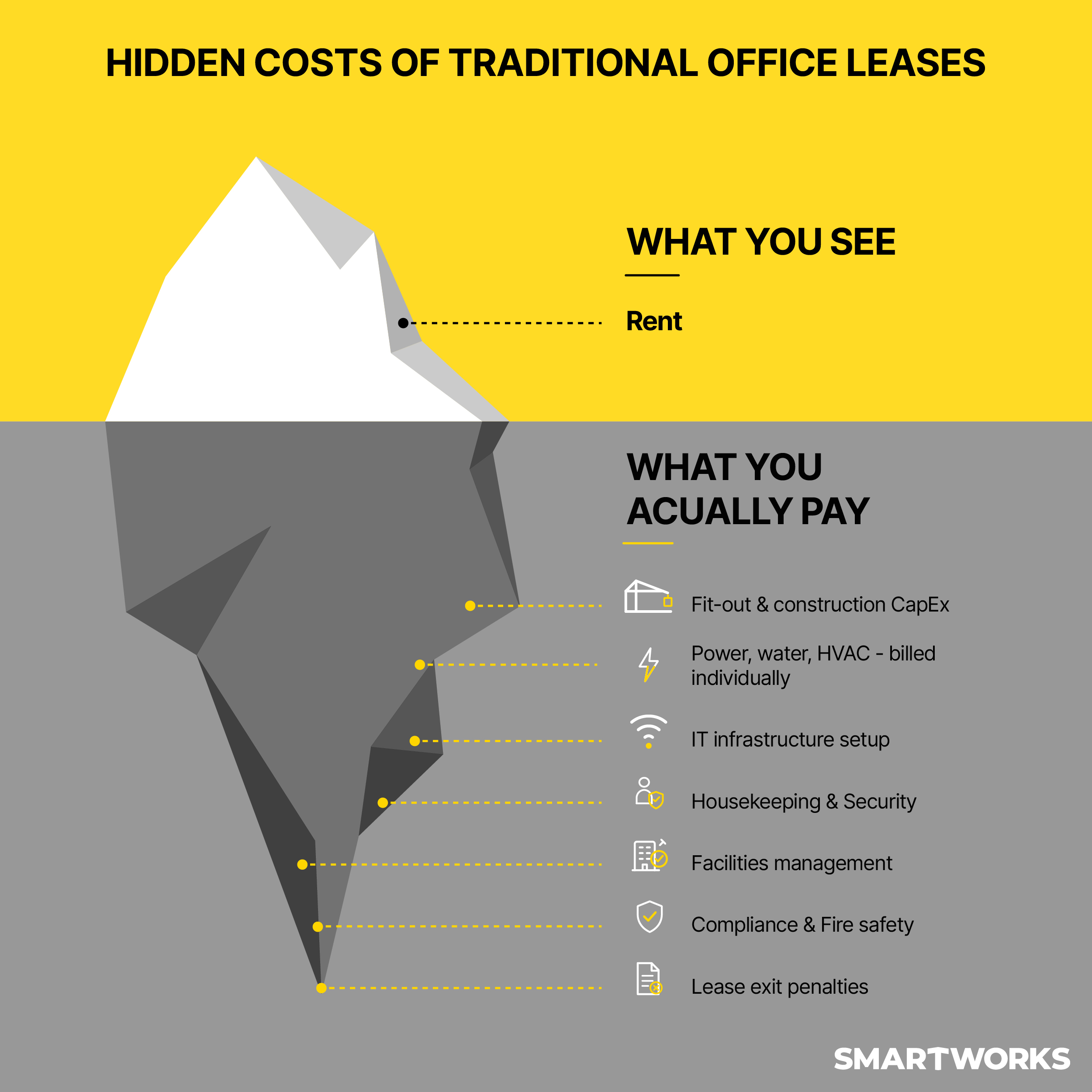
The headline rent per square foot is the least complicated line on a traditional lease budget. The rest of it looks like this:
- Separate vendor contracts for internet, AMC, housekeeping, and security
- Fit-out and construction capex; a new build-out each time
- Power, water, and HVAC billed individually
- An internal team to manage all of it
- Compliance, fire safety, and facilities staffing as ongoing line items
For organizations with stable headcounts and a long planning horizon, a traditional lease can still make sense. For teams in growth mode, it is a significant capital commitment to a fixed assumption about the future.
Why Companies Are Moving to Managed Offices
The shift to managed offices on an enterprise scale is not driven by preference. It is driven by a straightforward financial and operational logic that becomes harder to argue against the larger the team gets.
The Total Cost Argument
The financial case for managed offices is not simply that they are more convenient than a traditional lease. It is that they are cheaper, once you calculate the actual cost of a traditional lease honestly. When fit-out capex, security deposits, facilities staffing, utility contracts, and the internal time spent managing vendor relationships are in the same column, managed office pricing becomes the operationally and financially rational choice for most large teams.
What Does a Managed Office Fee Include?
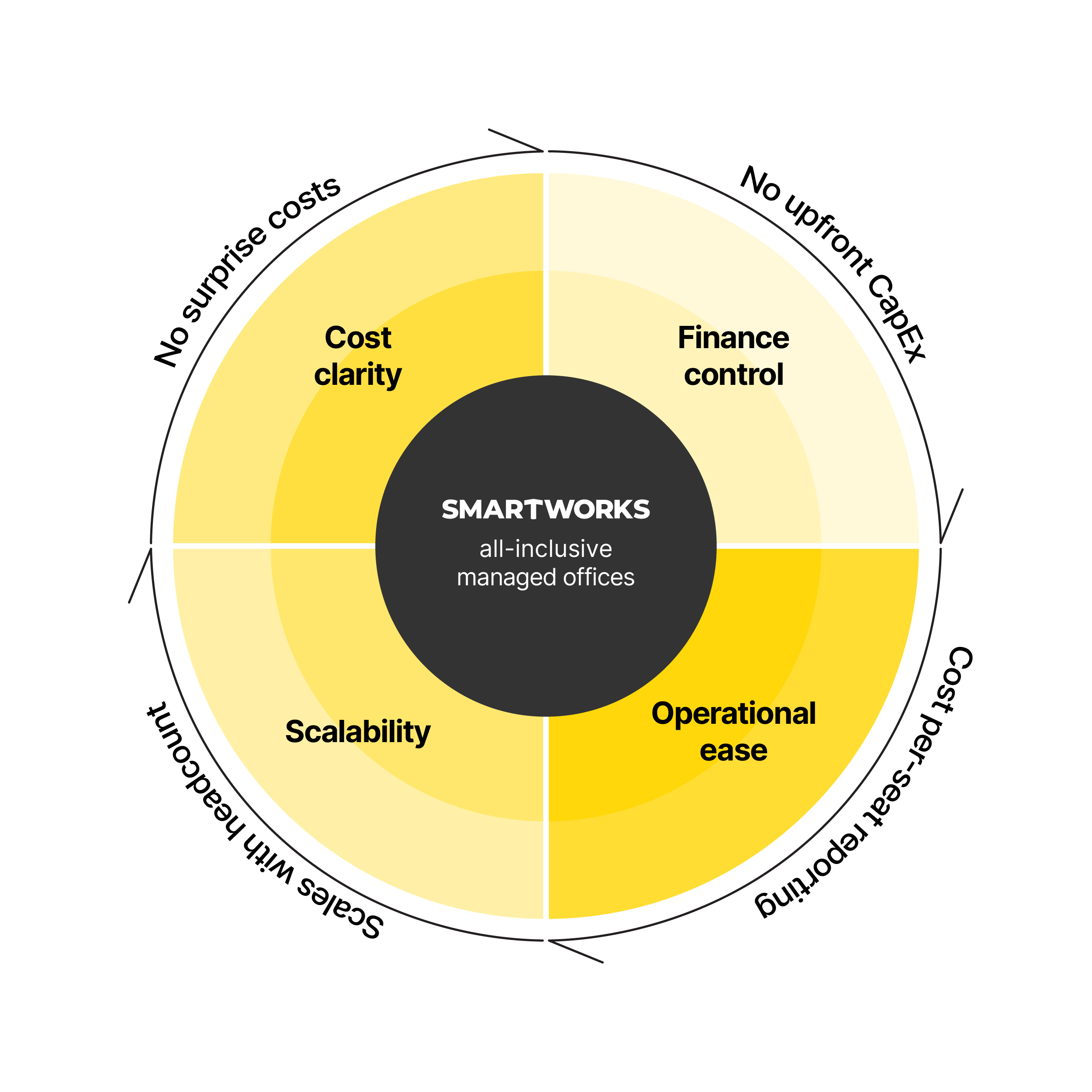
A managed office typically operates on a single, all-inclusive monthly fee. This covers:
- Dedicated, fully built office space
- Custom branding and layout to your specification
- IT infrastructure and network setup
- Housekeeping and security
- Facilities management
Remember: All-inclusive pricing isn't just convenient; it's an enterprise finance team's best friend.
The Operational Argument
Traditional leases require organizations to become, in effect, their own facilities management company. Managed offices outsource that entirely. A single vendor is accountable for the full operational experience. From infrastructure uptime to housekeeping to compliance, all under one predictable monthly fee. The internal bandwidth that would otherwise go into vendor management goes back to the business.
The Expansion Argument
For organizations planning multi-city growth, a managed office provider with pan-India presence eliminates the need for separate lease negotiations, fit-out timelines, and vendor setups in each new market. A campus in Hyderabad and a campus in Kolkata can be operationally identical.
The managed model makes standardized, scalable expansion possible in a way that traditional leasing structurally cannot match and coworking, by design, was never built to deliver.
The Talent and Experience Argument
Optimized, amenity-rich campuses consistently deliver higher employee productivity and retention. A workspace that reflects the organization in its brand, its layout, and its quality is no longer a cosmetic consideration at enterprise headcount. It is a talent retention lever.
How to Decide
Choose a traditional lease if:
- Your headcount is stable and predictable over five or more years
- Your sector requires proprietary infrastructure that cannot be delivered within a managed model
- You are in a Tier 2 market where quality managed office supply is limited
Choose coworking if:
- You are testing a new city with a small team
- Your horizon is under twelve months
- You need satellite access for a distributed workforce rather than a permanent base
Choose a managed office if:
- You are at 50 seats or above
- You need a workspace that is exclusively yours
- You want a single vendor accountable for the full operational experience
- You are planning to expand across cities in the next two to three years
At A Glance: Workspace Model Comparison
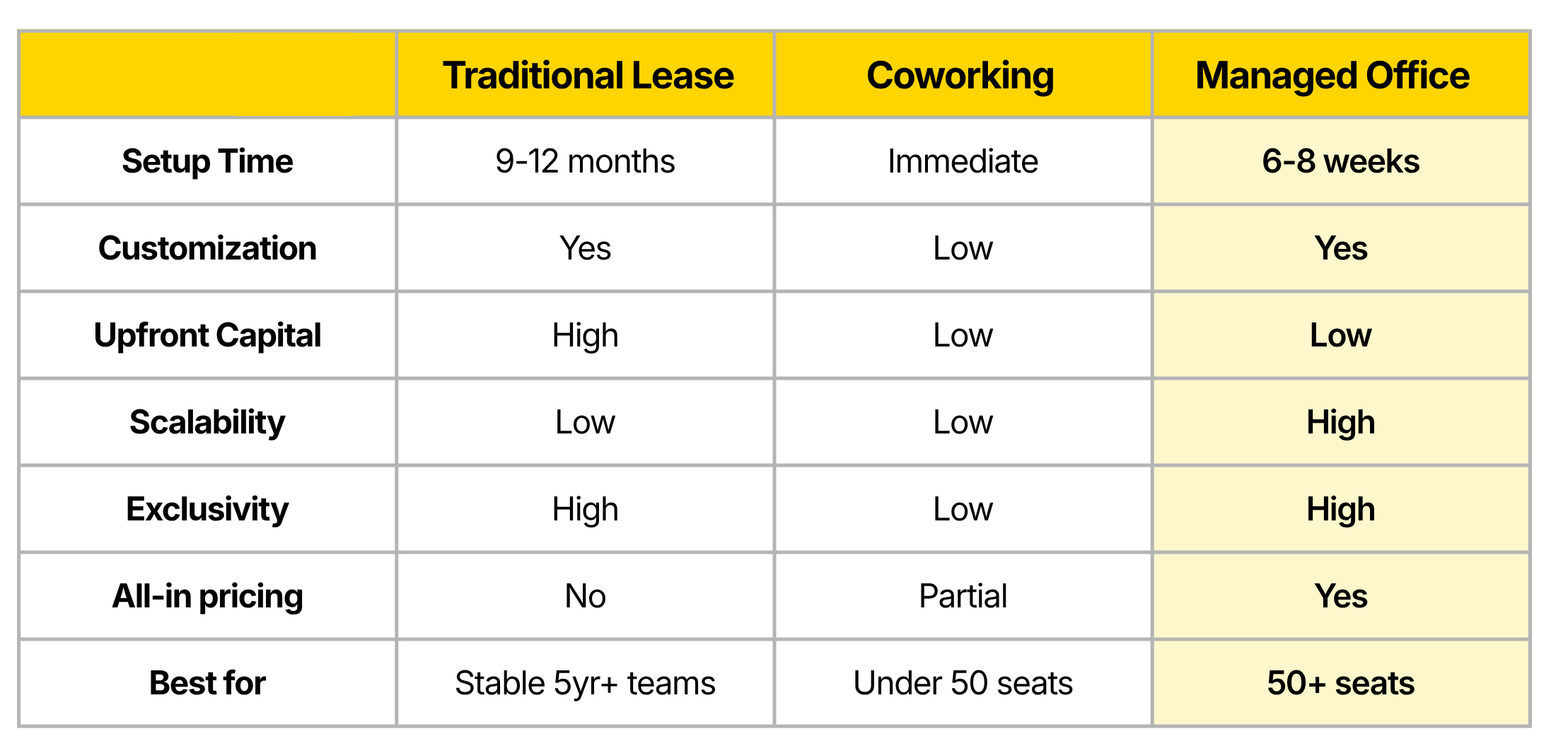
For large teams in India navigating this decision, managed office is the model built for how large teams work now.
Smartworks offers something that becomes increasingly rare at the enterprise scale - a workspace that is genuinely ready when you are. Custom-built to your specifications, consistent across cities, and managed end-to-end, so your operations team is not carrying a real estate problem on top of everything else.
Frequently Asked Questions
On total cost, usually yes - once fit-out, deposits, facilities staff, and utilities are in the same column.
Most providers start at 50 seats. Below that, coworking offers better value. At 300+, managed is hard to beat.
Coworking is shared with restricted scalability. A managed office is exclusively yours - your layout, your brand, your infrastructure. No one except for you and your team works in that space.
Yes. Providers like Smartworks with pan-India presence can replicate your setup across cities without separate lease negotiations in each market.