Office Location Strategy: How to Choose the Right Business Hub
 22 Jul
Key Takeaways
- Office location is a multi-year business decision that shapes hiring, cost, and growth.
- The right hub changes by company stage: startups, scaling firms, and enterprises should optimise for different things.
- Managed workspaces remove fit-out timelines and operational overhead, letting companies scale faster.
Most companies pick a city. The smart ones pick a micro-market.
Choosing an office is a multi-year strategic bet. Over that period, your address decides who applies to work for you, how fast you can expand, and what a client assumes about you before they've reached your reception. Rent, the number everyone negotiates hardest on, often turns out to be the least consequential line in the equation.
Why Office Location Is a Business Strategy
An office location shapes three things no interior fit-out can fix later: your talent catchment, your cost structure, and your room to grow in place.
Take commute alone. In Bengaluru or Mumbai, two micro-markets in the same city can mean a 25-minute commute versus a 75-minute one for the same team. That gap shows up in attrition data within a year, and in offer-acceptance rates even sooner.
The same logic plays out with clients. A CXO visiting your office forms an opinion before the meeting even starts. In our country where a large share of B2B deals still close in person, that first impression is doing more work than most decks give it credit for.
5 Factors to Consider When Choosing an Office Location
1. Talent Access and Commute Radius
Here's the single best predictor of how fast you'll hire: what share of your target talent pool can reach your office inside 45 minutes. Everything else is secondary to this. In metro cities like Bengaluru and Mumbai especially, proximity to a metro line has become a dealbreaker for candidates weighing two offers. Commutes do shift decisions.
2. Connectivity and Infrastructure
Beyond the metro map, look at airport access for client-facing teams, arterial road connectivity for last-mile ease, and less glamorously, power reliability and telecom redundancy in the building itself.
Once transport, food, housing and services start clustering in one place, the whole area gets easier to work out of, and that compounding is really what you're paying for when you pick a mature corridor over a newer one.
3. Scalability and Flexibility
Ask whether the hub and the specific building can absorb your growth. Not just today's headcount but the version of your team eighteen months out. Is there a floor you could take next door? Does the surrounding micro-market have enough live Grade A supply that expansion doesn't mean splitting your people across two ends of the city?
Micro-markets with active new supply, like Hyderabad's HITEC City corridor or Pune's Hinjewadi, give growing companies room that saturated central districts simply can't.
4. Business Ecosystem and Client Proximity
Who's around you matters more than it seems. Fintech firms cluster near banking hubs for a reason and GCCs sit inside IT corridors because vendors, partners, and specialised talent are already there. Proximity to clients shortens sales cycles, and proximity to peers builds hiring pipelines. And yes, the address on your pitch deck still does quiet work on your behalf.
5. Future Infrastructure Momentum
Every established corridor was once an emerging one. Look at what's funded and under construction - metro extensions, expressways, new Grade A supply, because a hub's trajectory over your lease term matters as much as its present state. Choosing a micro-market with momentum means the location gets better while you're in it.
CBD, SBD or Emerging Micro-Market: Which Hub Fits Your Stage?
India's office hubs broadly fall into three archetypes, and the right one depends on where your business is in its life cycle.
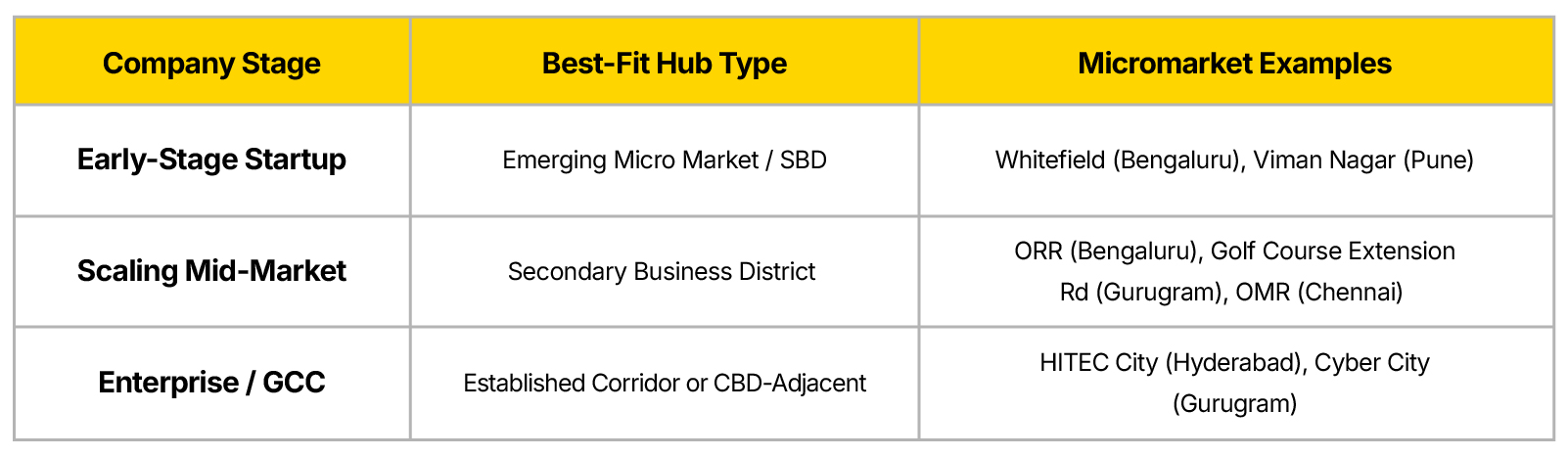
A useful rule of thumb: startups should optimise for runway, scaling firms for talent density, and enterprises for consolidation and ecosystem. Trouble usually starts when companies optimise for the wrong stage, the startup paying CBD rents, or the enterprise scattered across four buildings because the first leasing decision didn’t consider scalability.
How Managed Workspaces De-Risk the Location Decision
Every factor above carries the same underlying risk: committing capital and years to a guess about the future. Managed workspaces exist to soften exactly that.
With a managed office in a hub like ORR, Cyber City, or HITEC City, the fit-out is already done, the cost per seat is predictable, and scaling up is merely a conversation away instead of being a construction project. The benefits include -
- Ability to enter the right micro-market in weeks
- Ability to expand within the same campus as you grow
- Predictable costs
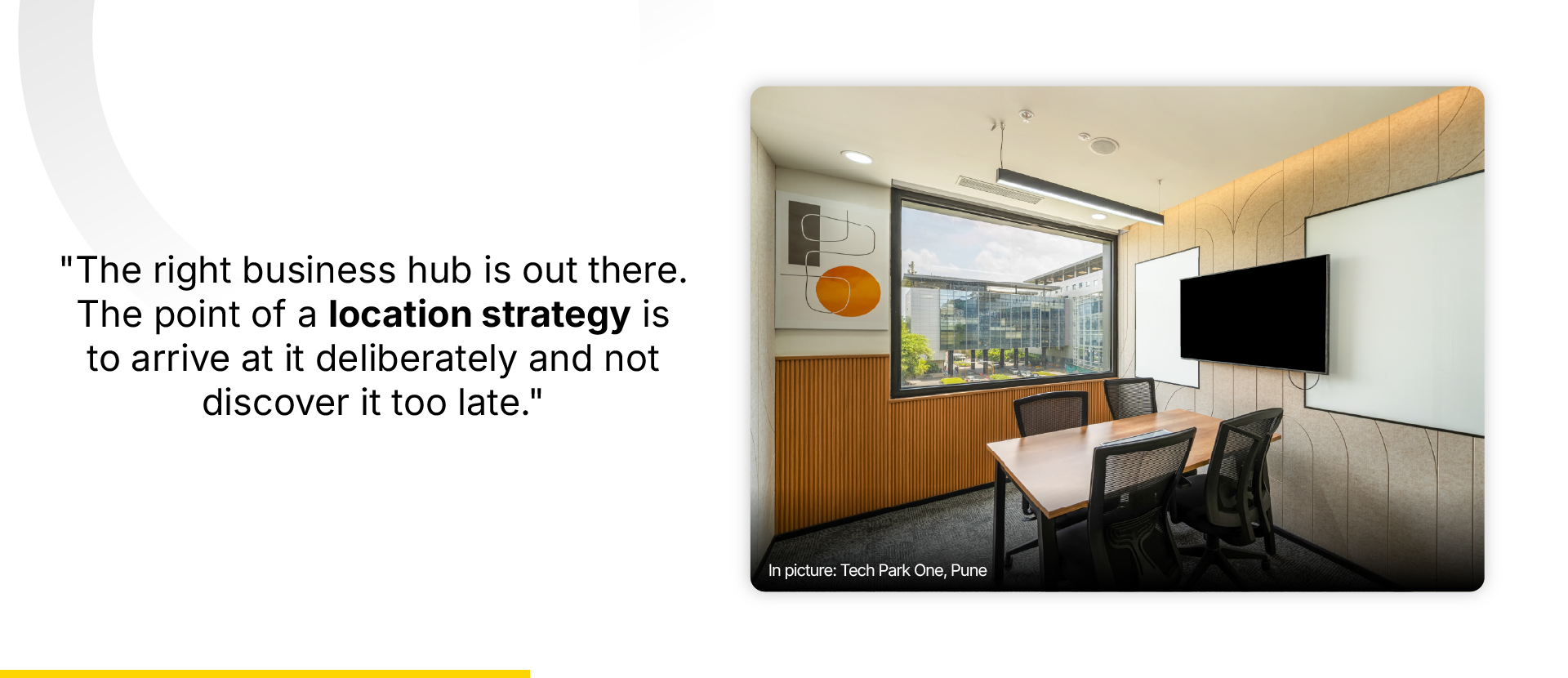
Smartworks operates Grade A managed campuses across India's major business hubs - including ORR and Whitefield in Bengaluru, Golf Course Extension Road and Cyber City in Gurugram, HITEC City in Hyderabad, OMR in Chennai, and Baner in Pune.
Each campus is built to a consistent standard: Grade A infrastructure, dedicated facility management, and the kind of amenities that support productivity from day one, not just move-in ready on paper.
For a company evaluating hubs, this changes what the decision requires. Instead of separately assessing a micro-market, a building, a fit-out partner, and an operations team, the evaluation collapses into one. With Smartworks‘ presence across India's major business hubs, that evaluation is usually a short one.
Frequently Asked Questions
Talent access. An office within a 45-minute commute of your target talent pool improves hiring velocity and retention more than any other single factor.
For client-facing enterprises and firms that trade on prestige, often yes. For scaling companies, secondary business districts usually offer better talent density per rupee.
They remove fit-out capex, convert costs into a predictable per-seat model, and let you scale within the same campus smoothly.
Early-stage companies are usually better served by an emerging micro-market that offers strong talent access at a more accessible entry point. A central, high-prestige address matters more once client-facing meetings and brand perception become a bigger part of the business.
Yes, significantly. Commute time is one of the most consistent predictors of attrition teams with a long or unreliable commute tend to see higher exit rates within the first year, regardless of how strong the role or compensation is.