The Shift from Traditional Leases: Why Indian Enterprises are Choosing Managed Offices
 03 Jul
Key Takeaways
- Traditional leases in India generally last five to nine years, while businesses today need the flexibility to adapt much more quickly.
- Managed offices give enterprises the flexibility to grow or shrink in any location.
- Enterprises can now get customized, fully equipped offices without having to own or manage the buildings themselves.
Three months ago, a mid-sized enterprise was running comfortably out of a single floor in Pune. Today, it's signing for a managed office space in Bangalore, faster than the hiring plan ever accounted for. Good problems are still problems when the old playbook doesn't quite stretch to cover them.
For years, office space was treated as fixed, something to plan everything else around. Now it's a lever, one that should move when the business moves.
Why Enterprises Are Rethinking Traditional Leasing
For a long time, traditional leases weren't really a constraint. They fit a world that moved slowly enough to plan for. In 2026, as we write this, that world has changed.
Hiring plans now move on a quarterly rhythm, not an annual one. Hybrid policies are still being written and rewritten in real time. A market that looked promising in January can look very different by the time a renewal is due. Economic outlook changes quickly, sometimes overnight, shaped by forces no enterprise ever had on its planning calendar. Think a distant conflict that disrupts a supply chain, or a health crisis that reshapes how people expect to work from then on.
“AGAINST THIS BACKDROP, FLEXIBILITY HAS BECOME JUST AS IMPORTANT
TO ENTERPRISES AS STABILITY ONCE WAS."
What's Pulling Enterprises Toward Managed Offices?
Ask any enterprise in India why they made the switch to a managed office space, and similar reasons will come up. Different words, same underlying logic: the managed model gave them room to move at the pace their business needed.
It's the question at the centre of every managed office vs traditional lease decision: how much flexibility does growth call for?
- Growth and change are harder to predict than they used to be. Few businesses can say with confidence what their team will look like year on year. A lean team today might need to double by next year, or scale back just as quickly.
- Traditional offices can also be more expensive upfront. Furniture, equipment, and technology all must be bought and built out before anyone moves in, while a managed office comes with that already in place.
- Running an office takes real time and attention. Facilities, vendor coordination, compliance paperwork, the everyday details that come with maintaining a physical space - and it's worth asking whether that's the best use of a team's time.
None of these things happens in isolation. Usually, a company runs into two or three of them at once, and that's typically the moment someone finally asks whether there's an evolved model that can handle this better.
Is There Still a Place for the Traditional Lease?
Yes, here’s why - A traditional lease can still suit a company that's confident about its space needs for the next several years and prefers to negotiate its own terms over time.
Some flexibility exists within traditional leases too, through renegotiation, sub-leasing, or expansion clauses, but those changes typically take longer to put in place. For a business that can work within that timeline, a traditional lease remains a reasonable option.
“THIS ISN'T REALLY A STORY ABOUT ONE KIND OF OFFICE REPLACING ANOTHER. IT'S A STORY ABOUT ENTERPRISES HAVING MORE WAYS TO THINK ABOUT REAL ESTATE THAN THEY DID BEFORE.”
How Smartworks is Redefining the Managed Office Model
Pan-India Scale, Built for Enterprise
Smartworks covers fifteen Indian cities and has a foothold in Singapore. For an enterprise, that means one phone call when a new market opens, not a fresh property search every time.
Design. Build. Manage: Delivered in 60 Days
Most fit-outs take months. Vendors, approvals, the inevitable delay nobody planned for. Smartworks gets it done in 60 days, from design through to ongoing management.
Large Campuses with Enterprise-Grade Amenities
Smartworks campuses come with the amenities that shape a 40-hour work week: cafeterias, gyms, crèches, medical centres, even smart convenience stores.
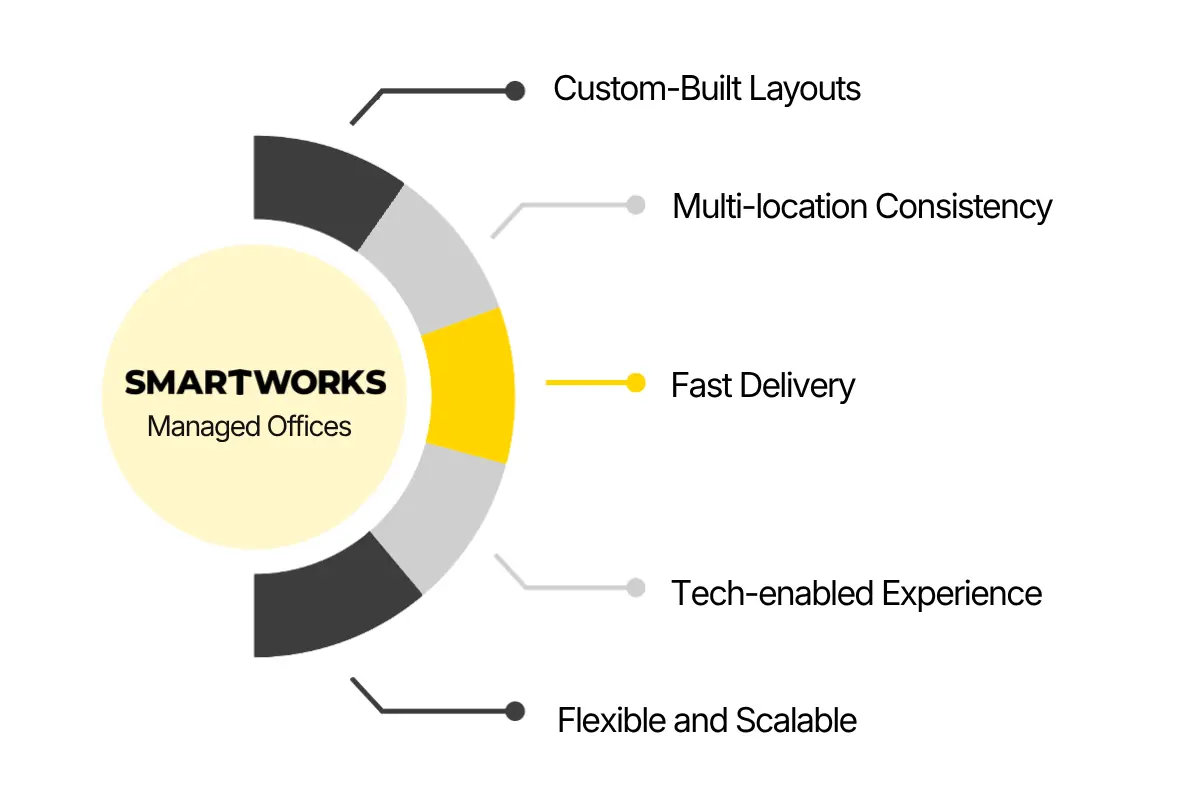
Scale, speed, and design add up to an experience that enterprises and high-growth Indian companies can feel in their day-to-day operations. That's the real test Smartworks is built to pass: a fully managed office that shows up ready, grows when the business does, and never asks anyone to choose between moving fast and moving well.
Frequently Asked Questions
Smartworks managed offices are ready in 45 to 60 days, depending upon the custom requirements, against four to six months or more for a traditional lease fit-out.
Yes. Adding seats, expanding floors, or relocating is far simpler than renegotiating or exiting a traditional lease.
When headcount is stable, the company plans to stay in one location for 7 to 10 years and prefers to manage facilities in-house.
Yes, customization can be done across layout, branding, and design elements. Smartworks works closely with enterprises on this, so the space reflects their identity rather than feeling like a shared template with a logo added on.